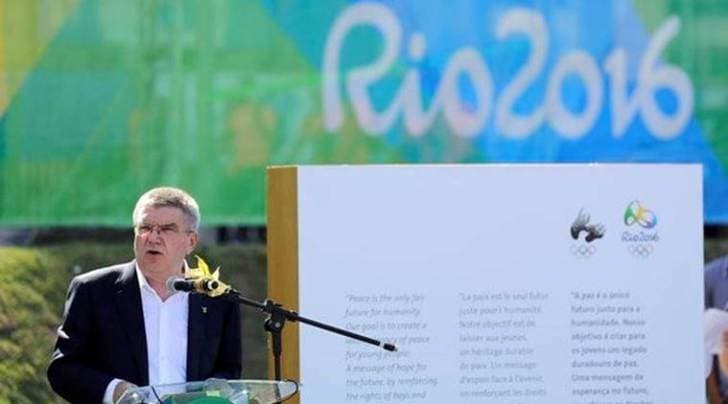
 Another would be for individual IOC members to cease attacks on the WADA that commissioned the report. REUTERS
 The International Olympic Committee (IOC) lost the anti-doping battle at Rio but can redeem itself in time for the 2018 Pyeongchang Winter Games, anti-doping officials said on Thursday.
The 59-member global Institute of National Anti-Doping Organisations (iNADO) said in a strongly-worded statement that the IOC had “failed the clean athletes of the world” at the Summer Games in August.
The IOC resisted calls for a blanket ban on Russians competing in the Games due to the country’s doping record, leaving decisions on individual athletes’ participation with their sports federations.
Last month’s Paralympics did ban all Russian athletes.
-
 Mirzya Audience Reaction: Harshvardhan Kapoor & Saiyami Kher’s Debut Gets A Mixed Response
 -
 Wing Part Found In Mauritius Confirmed To Be Part of MH370, Says Malaysia
 -
 BJP Slams Rahul Gandhi For His ”Dalali” Remarks At PM Modi
 -
 Apple iPhone 7 Plus Camera Review And Image Test
 -
 Interview With Mirzya Stars Harshvardhan Kapoor, Saiyami Kher And Director Rakeysh Omprakash Mehra
 -
 Those Seeking Proof Of Surgical Strikes Not Loyal, Says Defence Minister Manohar Parrikar
 -
 Millions Flee Inland As Southeast US Braces For Hurricane Mathew
 -
 Madras High Court Dismisses Petition Seeking Photographs Of Jayalalithaa In Hospital
 -
 Your Favourite Soft Drink Brand Could Be Toxic, Here’s What A Study Found
 -
 Supreme Court Reserves Order Till Friday On BCCI’s Non Compliance Of Lodha Report
 -
 India Responds To Pakistan’s Allegations At UN, Says Jammu & Kashmir Integral To India
 -
 3 Militants Dead After Attack On Army Camp In Handwara, J&K
 -
 Rohith Vemula Not A Dalit, Neither His Mother: HRD Commission’s Findings
 -
 Wankhede Brawl Case: Shahrukh Khan Gets Clean Chit By Mumbai Police
“Sadly for sport, just as the 1988 Seoul Olympic Games are remembered by (Canadian sprinter) Ben Johnson’s infamy, this year’s Games will be remembered by participation of athletes served by a Russian system that corrupted clean sport,” iNADO said.
“Equally disappointing, in the eyes of many the IOC chose to associate itself with such a system by failing to reject it categorically.”
Joseph de Pencier, chief executive of iNADO, said the IOC must ensure that “the reception of Russian athletes in Pyeongchang is very different than the one in Rio.”
iNADO said a starting point would be for the IOC to recognise that the findings of the McLaren report, which revealed the system of state-sponsored doping in Russia, were well-documented and reliable.
Another would be for individual IOC members to cease attacks on the World Anti-Doping Agency (WADA) that commissioned the report.
It added that whistle-blowers should be encouraged and WADA’s independence strengthened, with the agency given the investigative capacity it needs.
Governance in sporting organisations needed to be improved to restore confidence, with public oversight of operations and spending.
iNADO also suggested that Olympic sponsors and broadcasters should “contribute meaningfully” to anti-doping, if only to protect their own substantial investments.
It said the task of convincing Russia, its athletes and the country’s sporting leaders of the cultural change needed was “enormous”.
“Anti-doping is not “political” — it is at the heart of true sport. Let the IOC help us hear Russian voices acknowledge that and see Russian decision-makers act on it,” said the institute.
No comments:
Post a Comment